High-Performance CSS Animation and Transition Patterns

The evolution of cascading style sheets (CSS) has transformed the language from a rudimentary, declarative layout mechanism into a highly sophisticated, high-performance rendering engine capable of executing complex motion graphics and interactive choreographies natively within the browser environment.
Modern digital interfaces demand fluid, 60 to 120 frames-per-second (FPS) micro-interactions, hardware-accelerated dimensional transformations, and deeply integrated state transitions.
Achieving this optimal level of performance requires a nuanced understanding of browser rendering pipelines, the strategic isolation of composite layers, and the rigorous implementation of scalable design token architectures.
The analysis contained in this report exhaustively details the underlying architectural patterns, advanced synchronization techniques, and rendering heuristics necessary to engineer smooth, performant, and maintainable CSS animations for enterprise-grade design systems.
I. Architectural Foundations of the Browser Rendering Pipeline.
To effectively engineer performant CSS animations, it is first necessary to completely deconstruct the browser's rendering pipeline. When a browser process begins receiving HTML data, the main thread initiates a sequential series of parsing and calculation operations to convert high-level code into graphical pixels mapped to the user's display.
This precise pipeline dictates the computational cost of any given animation, as triggering an early stage in the sequence inherently forces the recalculation of all subsequent downstream stages.
The initial phase involves parsing the raw HTML to construct the Document Object Model (DOM) alongside the concurrent parsing of stylesheet data to build the CSS Object Model (CSSOM). During this stage, the rendering engine tokenizes the CSS syntax, explodes shorthand properties into their longhand variants for easier internal processing, and reduces all property declarations to standardized computed values.
Dimensional units are eventually resolved into either auto, percentages, or absolute pixel values. Simultaneously, the engine evaluates cascading origins - sorting declarations by user agent, author, and user origins - while applying the specificity algorithm to resolve conflicting rules based on the density of ID, class, and tag selectors. Once the winning computed styles are determined, the CSSOM is synchronized to represent the parsed state accurately.
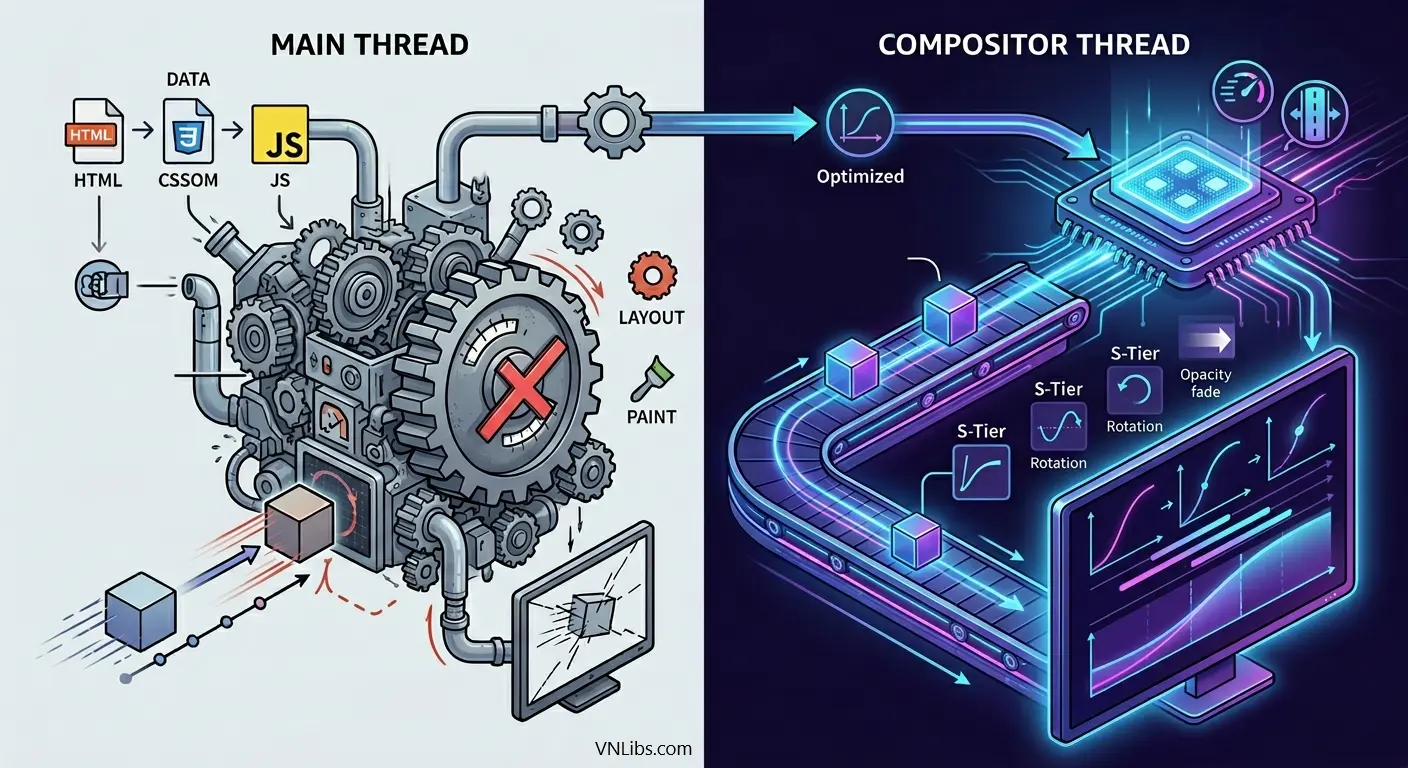
Following style calculation, the browser initiates the Layout phase, also referred to as reflow. The main thread traverses the DOM tree to construct a visual box tree, establishing the precise geometry, coordinates, and bounding box dimensions of all visible elements. The Layout calculation is an inherently expensive and synchronous operation.
Because the document flow is mathematically interconnected, altering the dimensions of a single node - such as animating its width - can trigger a chain reaction of recalculations rippling from the bottom of the node tree back to the root container.
This phase also resolves Formatting Contexts dictated by the display property, establishes Containing Blocks, and performs "shrink-to-fit" calculations for floated and absolutely positioned elements by executing content measurements in infinite space.
Subsequent to Layout is the Paint phase, wherein the browser determines the precise stacking order dictated by z-index stacking contexts and translates the geometric box coordinates into visual bitmaps using software rasterizers.
The painting order rigorously follows CSS specifications, drawing the background, followed by the borders, and finally the content. In modern rendering architectures, painting is frequently the most computationally intensive task executing on the main thread.
The ultimate stage of the rendering pipeline is Compositing. The compositor thread separates the rendered bitmaps into distinct layers, dividing these layers into tiles that are processed by raster threads.
These rasterized bitmaps are uploaded into Graphics Processing Unit (GPU) memory. The compositor thread then gathers draw quads—information defining tile location and page placement—to construct a final compositor frame, which is dispatched to the GPU for actual display on the monitor.
II. GPU Memory Optimization and Hardware Acceleration Mechanisms.
The categorization of animation performance is entirely dependent on which stages of the rendering pipeline a specific CSS property invokes during its transition sequence. High-performance animations must circumvent the Layout and Paint phases entirely, operating exclusively at the Composite tier.

Senior Software Architect & Open‑Source Maintainer
Dr. Marcus Hale holds a PhD in Computer Science from Carnegie Mellon University. He specializes in curating secure, production‑ready code snippets and software architecture best practices.