Psychology of Magnetic Personal Branding in the Creator Economy

The digital landscape has fundamentally shifted from an attention-based economy to a community-centric ecosystem. In an era where generative artificial intelligence can commoditize information and replicate aesthetic perfection at scale, the sheer visibility of a brand is no longer a sustainable competitive advantage.
Contemporary personal branding transcends the superficiality of visual identifiers, such as logos, typography, and color palettes, demanding instead a profound psychological architecture. The most magnetic personal brands function as cognitive and emotional anchors for their audiences.
They align intimately with the human psyche, leveraging established psychological frameworks to build unwavering authority, cultivate deep-seated trust, and mobilize highly engaged communities around a singular, authentic voice.
The purpose of this comprehensive report is to rigorously deconstruct the psychological mechanics underlying successful personal branding for content creators, thought leaders, and executives.
By synthesizing cognitive psychology, narrative theory, Jungian archetypal mapping, and advanced community-building frameworks, this analysis delineates the precise methodologies through which individuals can construct resilient, deeply influential digital identities that transcend the noise of the modern creator economy.
1. The Cognitive Psychology of Brand Perception and Processing.
The initial interaction between a consumer and a personal brand is rarely analytical; it is overwhelmingly intuitive and driven by cognitive heuristics.
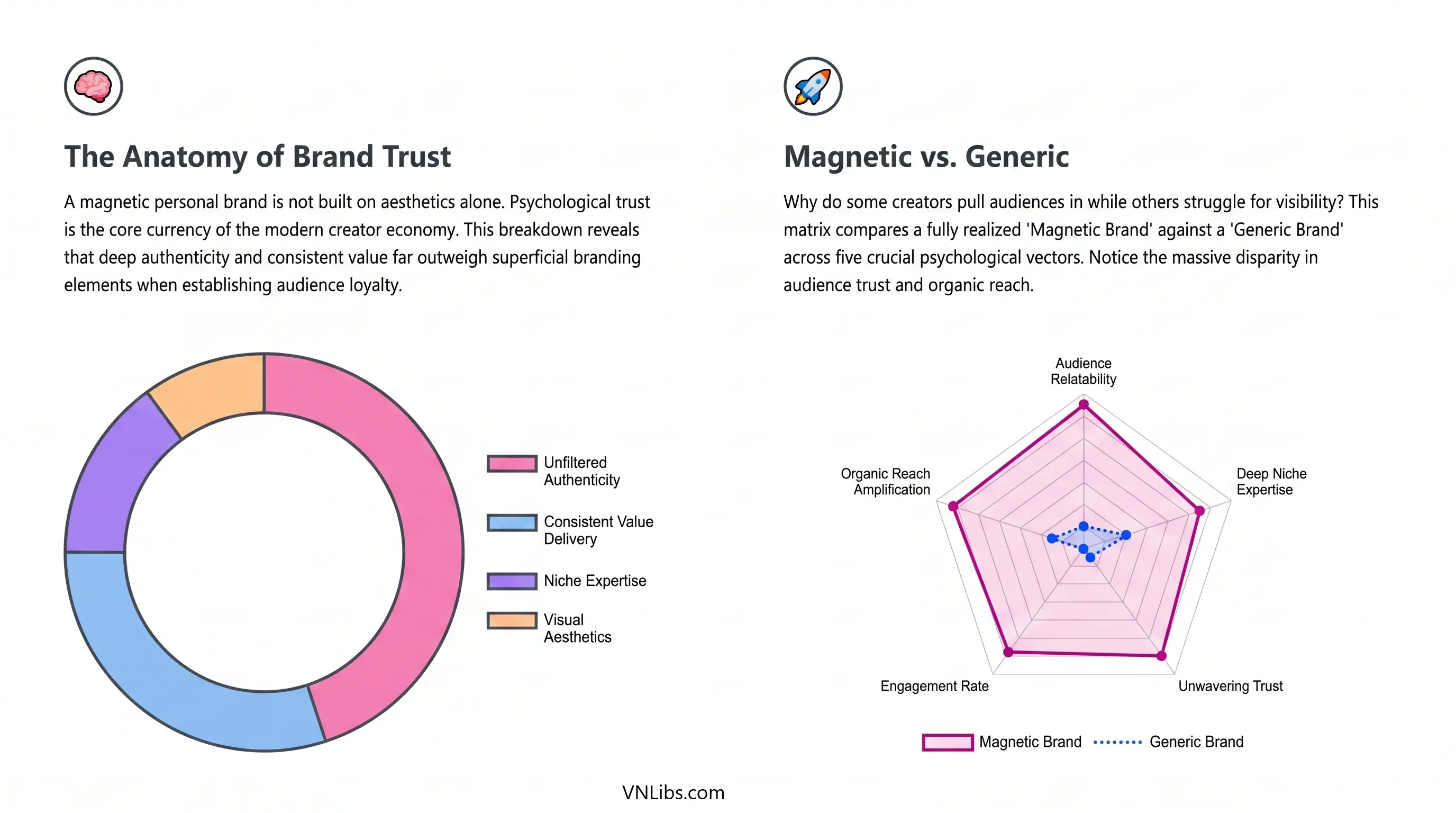
Understanding how the human brain processes, categorizes, and trusts information is the foundational step in architecting a magnetic brand presence.
Consumers are inundated with between 4,000 and 10,000 advertisements and brand impressions daily. Consequently, the human brain ruthlessly filters out stimuli that require excessive mental effort.
1.1. Cognitive Load Theory and the Four C's Framework.
At the bedrock of optimal brand perception is the mitigation of cognitive load. When educational or marketing content is presented in ways that align with how human brains process and remember information, engagement deepens significantly. This principle is operationalized through the "Four C’s" framework: Clarity, Consistency, Content, and Communication.
Clarity involves possessing an unequivocal understanding of the brand's core values and positioning, ensuring that the audience expends minimal mental energy decoding who the creator is and what they represent.
Consistency refers to the unwavering representation of these values and visual attributes across all platforms and interactions. By maintaining a highly consistent visual and thematic system—utilizing specific typographic hierarchies and recurring narrative motifs—creators facilitate cognitive ease.
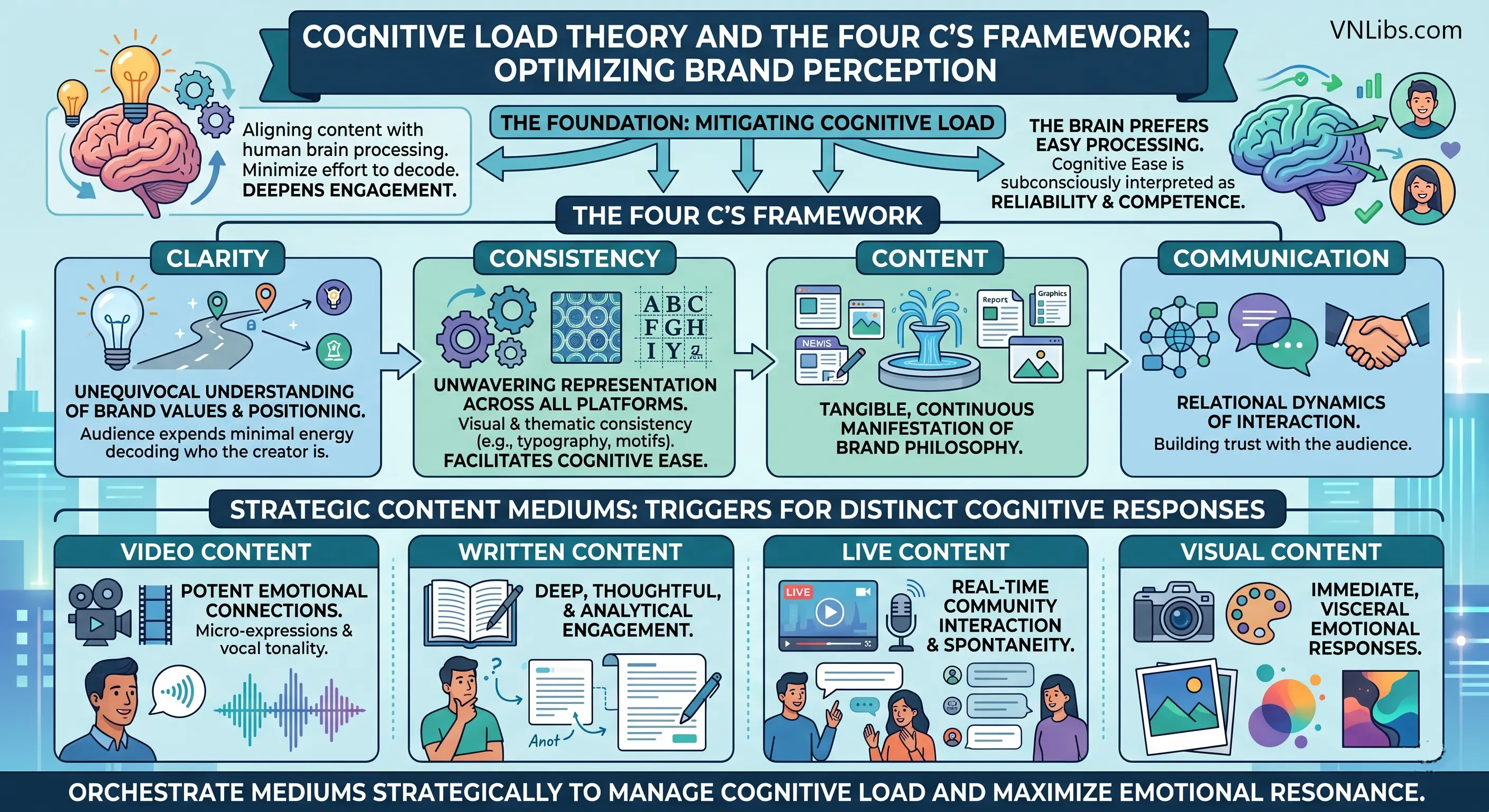
Content serves as the tangible, continuous manifestation of the brand’s core philosophy, while Communication governs the relational dynamics of how the brand interacts with its audience to build trust.
The brain naturally prefers stimuli that are easy to process, and over time, this cognitive ease is subconsciously interpreted by the audience as reliability and competence. Furthermore, creators must recognize that different content mediums trigger distinct psychological and cognitive responses.
Video content builds potent emotional connections due to the transmission of micro-expressions and vocal tonality; written content allows for deep, thoughtful, and analytical engagement; live content fosters real-time community interaction and spontaneity; and visual content triggers immediate, visceral emotional responses.
A sophisticated personal brand orchestrates these mediums strategically to manage the cognitive load of their audience while maximizing emotional resonance.
1.2. The Mere Exposure Effect and the Dual Mediation Hypothesis.
The psychological necessity of consistency is scientifically grounded in the mere exposure effect, a cognitive phenomenon wherein individuals develop a preference for things simply because they are familiar with them.
In the context of brand strategy, frequent, neutral, or positive exposure to a creator’s content systematically builds psychological comfort and trust over time.
The mere exposure effect operates primarily on a subconscious level; in fact, conscious awareness of the repetition can occasionally diminish its positive impact.
If a consumer encounters a creator’s visual elements, tone, and messaging repeatedly, the neural pathways associated with that creator are strengthened, facilitating faster recognition and reducing initial skepticism.
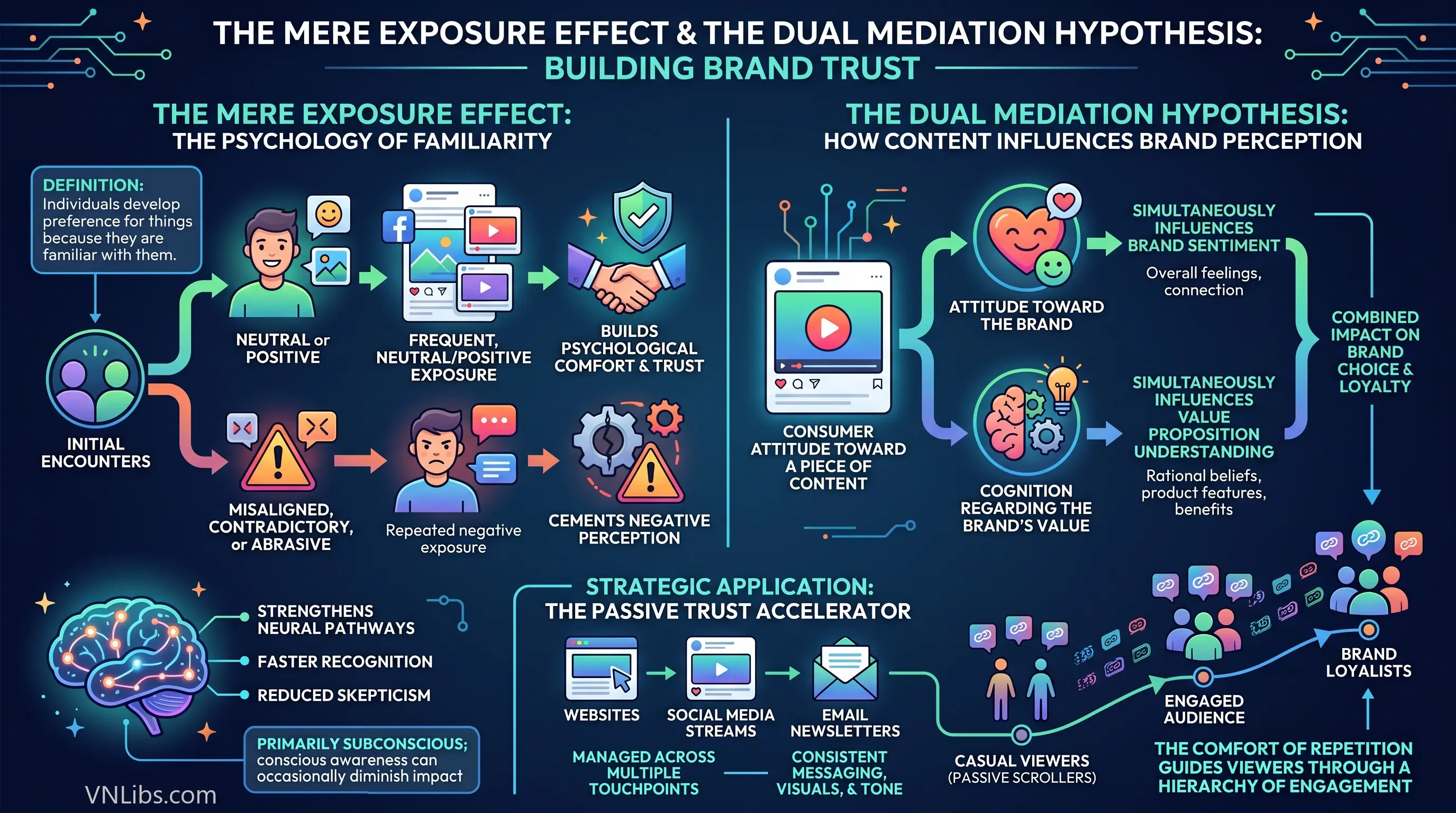
However, the foundational prerequisite for this phenomenon is that the initial encounters must be neutral or positive. Repeated exposure to a misaligned, contradictory, or abrasive brand message will inversely cement a negative perception, making it nearly impossible to rehabilitate the brand's image later.
This phenomenon is further elucidated by the dual mediation hypothesis, which posits that a consumer's attitude toward a piece of content or advertisement simultaneously influences their attitude toward the brand as a whole and their cognition regarding the brand's underlying value proposition.
When effectively managed across multiple digital touchpoints—such as websites, social media streams, and email newsletters—the mere exposure effect acts as a passive trust accelerator.
It organically guides casual viewers through a hierarchy of engagement, transforming passive scrollers into dedicated brand loyalists simply through the comfort of repetition.
1.3. The Synergy of the Halo Effect and Social Proof.
Authority, pricing power, and credibility are significantly accelerated by the strategic manipulation of two distinct but highly synergistic cognitive biases: the halo effect and social proof.
The halo effect is a cognitive bias wherein a positive impression in one specific domain unconsciously influences the audience's perception of the creator’s abilities in entirely unrelated areas. This heuristic functions as a mental shortcut.
For instance, if a creator demonstrates exceptional, undeniable competence in digital marketing strategy, the audience will naturally assume they also possess superior organizational skills, financial acumen, or leadership capabilities.
This "first impression bias" acts as a robust cognitive buffer; a powerful initial positive interaction can insulate the personal brand against future minor errors or negative experiences, providing a margin of safety for the creator.
Conversely, social proof relies on the psychological assumption that the collective behavior of a group reflects the correct, safe, or optimal behavior for the individual.
Rooted in Robert Cialdini’s principles of persuasion, social proof explains why visible expertise and community endorsement move purchasing decisions faster than logical explanations. In the creator economy, this manifests through user-generated testimonials, transparent audience engagement metrics, high-profile collaborations, and LinkedIn recommendations.
When strategically combined, these two biases create an exponential psychological flywheel. For example, when a highly trusted, mainstream influencer endorses an emerging creator, the established influencer's positive reputation (the halo effect) merges with the apparent consensus of their vast audience (social proof) to immediately and powerfully amplify the emerging creator's perceived authority.
| Cognitive Mechanism | Psychological Focus and Mechanism of Action | Strategic Application for Creators |
|---|---|---|
| Halo Effect | Individual attribute spreading to overall perception. Cognitive shortcut where one demonstrably positive trait creates a comprehensive positive impression across all domains. | Executing high-quality initial touchpoints; demonstrating extreme competence in a narrow niche to establish broad, generalized authority. |
| Social Proof | Group behavior and consensus evaluation. Assumed wisdom of the crowd; the human instinct to seek safety and validation in numbers. | Amplifying user-generated content, displaying subscriber metrics, leveraging testimonials, and securing peer endorsements. |
| Mere Exposure | Familiarity accumulated over time. Reduced cognitive load leading to subconscious preference, brand recall, and emotional comfort. | Maintaining omnichannel content consistency; enforcing strict visual and tonal guidelines across all platforms. |
| Confirmation Bias | Alignment with existing audience beliefs. The tendency to search for, interpret, and favor information that confirms prior hypotheses or values. | Framing novel concepts within the vocabulary and established worldviews of the target demographic to reduce resistance. |
2. Archetypal Psychology and Identity Mapping.
Beyond cognitive heuristics and biases, profound personal brands tap into the collective unconscious through archetypal positioning. Originating from the psychological theories of Carl Jung, brand archetypes are universal, primitive character models that resonate instinctively with human audiences.
They provide a psychological shorthand that aligns a brand with the deep-seated, often subconscious desires and fears of its target demographic, allowing the creator to bypass logical scrutiny and forge immediate emotional connections.
2.1. The Core Archetypes and Human Desires.
Every archetype is intrinsically linked to a core human desire. We are not taught to want these things; they are primitive and instinctive. By anchoring a personal brand to one of these core desires, creators ensure that their messaging strikes directly at the emotional imperatives of their audience.
| Brand Archetype | Core Human Desire and Primary Strategy & Brand Personality | Example Expression in the Creator Economy |
|---|---|---|
| The Ruler | Control and Stability. Providing structure, demonstrating absolute authority, and influencing market dynamics. | High-level business consultants dictating industry standards and corporate frameworks. |
| The Hero | Mastery and Legacy. Overcoming challenges, demonstrating bravery, and driving undeniable results through determination. | Performance coaches who emphasize grit, resilience, and dominating the competition. |
| The Magician | Power and Transformation. Acting as a visionary who challenges the status quo and transforms reality. | Tech futurists and AI strategists promising exponential growth and systemic evolution. |
| The Creator | Innovation and Expression. Inspiring authentic self-expression, out-of-the-box thinking, and fixing broken industry systems. | Digital artists and disruptive designers encouraging their audience to color outside the lines. |
| The Sage | Knowledge and Understanding. Seeking truth, offering wisdom, and acting as an approachable, highly intellectual guide. | Academic researchers, non-fiction authors, and thought leaders focused on data and philosophy. |
| The Caregiver | Service and Nurturing. Protecting the vulnerable, providing soft, safe, and empathetic support. | Mental health advocates and community managers focusing on holistic audience well-being. |
| The Outlaw / Rebel | Liberation and Disruption. Breaking rules, celebrating rebelliousness, and destroying outdated paradigms. | Provocative commentators who position themselves entirely against mainstream industry norms. |
| The Explorer | Freedom and Autonomy. Pursuing independence, adventuring into the unknown, and avoiding conformity. | Digital nomads and lifestyle entrepreneurs who sell the dream of location and financial independence. |
| The Everyman | Belonging and Connection. Demonstrating intense relatability, approachability, and down-to-earth values. | Lifestyle vloggers who focus on the mundane, shared realities of everyday life to build kinship. |
| The Jester | Enjoyment and Joy. Living in the moment, using humor to defuse tension, and promoting passionate playfulness. | Comedic commentators and entertainment-focused streamers who prioritize audience amusement. |
| The Lover | Intimacy and Passion. Building deep interpersonal relationships, focusing on sensuality, and emotional closeness. | Relationship experts and creators focusing heavily on vulnerability and intimate human connection. |
| The Innocent | Safety and Purity. Promoting simplicity, optimism, and a return to uncorrupted, pure values. | Minimalist creators focusing on slow living, organic lifestyles, and untainted environments. |
2.2. The Evolution of Archetypal Strategy and Hybrid Mapping.
While the traditional 12 Jungian archetypes remain the theoretical foundation, contemporary brand strategy has evolved significantly beyond rigid, one-dimensional applications.
Modern personal branding requires multi-dimensional, hybrid models that capture the inherent complexity of human creators while remaining psychologically coherent to the audience.
Creators are no longer confined to a single label. Instead, they adopt a primary archetype to dictate their overarching mission and structural positioning, paired with a secondary archetype to flavor their unique communication style and daily interactions.
For example, a creator might merge the Creator archetype (driven by innovation and a fearless vision for the future) with the Ruler archetype (driven by absolute authority and control), presenting as a formidable entity that redesigns the future with uncompromising competence, much like the corporate branding of Apple or Tesla.
Similarly, blending the Sage (wisdom, data-driven insight) with the Caregiver (service, empathy) yields a thought leader who is both deeply knowledgeable and intensely invested in the personal well-being of their audience, making complex information feel supportive rather than intimidating.
A combination of the Hero (determination) and the Magician (transformation) results in a highly motivational brand that promises profound, near-miraculous personal reinvention through hard work.
2.3. Data-Driven Approaches to Identity Mapping.
The mapping of an individual to an archetype in modern practice is not an exercise in arbitrary self-selection; it is a highly analytical, systematic process. The most successful creators engage in rigorous values-archetype alignment to ensure authentic positioning.
This contemporary methodology relies on comprehensive 360-degree assessments, where qualitative input is actively gathered from clients, peers, mentors, and the existing audience to identify the archetypal qualities that are already being perceived.
If a creator views themselves as a Ruler but their audience perceives them as an Everyman, this cognitive dissonance will fracture the brand's trust over time.
Advanced strategies now utilize data analytics and natural language processing (NLP) to perform semantic analysis on a creator’s written and verbal communication, evaluating how the audience describes the brand online.
AI systems can identify which specific brand expressions generate the strongest audience resonance, ensuring that the selected archetype perfectly overlaps with the audience's psychological expectations.
Furthermore, by examining competitive differentiation—analyzing the archetypes deployed by competitors within a specific niche—creators can visually and narratively identify unoccupied positioning opportunities, allowing them to capture unserved audience segments.
3. Narrative Architecture: The StoryBrand Framework and the Fallacy of the Hero.
If archetypes provide the psychological character model for a brand, narrative architecture provides the structural vehicle for its communication. Human brains are neurologically wired to process, retain, and recall information through narrative structures.
A personal brand without a coherent, ongoing narrative is merely a collection of isolated facts and abstract advice, which the human brain rapidly discards to save cognitive energy.
3.1. The Fallacy of the Hero’s Journey in Personal Branding.
Historically, a vast majority of personal brands have defaulted to the "Hero's Journey" (the monomyth), positioning the creator as the ultimate protagonist who overcame immense adversity to achieve greatness.
However, psychological and narrative analysis reveals this to be a catastrophic strategic error for audience conversion and community building.
When a creator positions themselves as the hero of the story, they inadvertently place themselves in direct competition with their audience. The audience is inherently seeking solutions to their own profound problems; they are searching for their own heroic triumph, not an opportunity to act as a passive spectator applauding the creator's past successes.
While a Hero's Journey might garner transient admiration, it fails to trigger the behavioral change necessary for monetization and deep loyalty, because the audience cannot see a role for themselves in the creator's localized narrative.
3.2. Shifting the Paradigm: Positioning as the Guide.
The StoryBrand framework, pioneered by Donald Miller, aggressively corrects this psychological misalignment by forcing a paradigm shift: the customer is unequivocally the Hero of the narrative, and the personal brand operates exclusively as the Guide.
Under this framework, the creator’s role is akin to Yoda in Star Wars or Dumbledore in Harry Potter—a wise, experienced, slightly peripheral entity whose sole purpose is to equip the hero with the tools, knowledge, and confidence necessary to conquer their challenges.
The StoryBrand architecture follows a strict, seven-part psychological progression that models the consumer purchasing and engagement journey:
- A Character (The Hero): The audience member, who deeply desires a specific, transformative outcome.
- Has a Problem: The narrative must articulate the external challenges facing the hero, the internal frustrations these challenges cause, and the philosophical injustice of the situation.
- And Meets a Guide: The personal brand enters the narrative not to boast, but to offer targeted solutions.
- Who Demonstrates Empathy and Authority: The Guide must prove they intimately understand the pain (empathy) while simultaneously demonstrating the competence required to solve it (authority).
- And Gives Them a Plan: A clear, step-by-step mechanism that reduces the cognitive friction, financial risk, and fear associated with engaging with the brand.
- That Calls Them to Action: A direct, unambiguous provocation requiring the hero to change their behavior, commit to a community, or make a purchase.
- Ending in Success and Avoiding Failure: The brand paints a vivid, dual psychological picture: the transformed, victorious state of success versus the tragic consequences of continued inaction and failure.
The critical axis of this framework, and the point where most creators fail, is step four: the delicate, precise calibration of Empathy and Authority.
Empathy without authority renders the creator highly relatable but practically useless; the audience feels heard and validated, but they do not trust the creator to actually fix the problem.
Conversely, authority without empathy renders the creator intimidating, arrogant, and clinical; the audience respects the creator’s competence but feels alienated and misunderstood.
By perfectly calibrating these two elements—often by sharing past struggles to build empathy while showcasing current results to build authority—a creator establishes an unbreakable narrative bond.
Testimonials, certifications, and awards should only be deployed as proof of the Guide's competence to help the Hero, never to glorify the Guide. When executed correctly, the creator's success becomes inextricably linked to, and defined by, the audience's triumph.

Creator Strategy Lead & Content Educator
Dr. Amelia Carter holds a PhD in Computer Science from Carnegie Mellon University. He specializes in curating secure, production‑ready code snippets and software architecture best practices.